


The History of the Poinsettia: Aztec Medicine Turned American Holiday Classic
While thinking about how to decorate for Christmas, I remembered the classic holiday flower: the Poinsettia. But why is it associated with Christmas? It is not mentioned in the Bible, and unlike Rudolph the Red-Nosed Reindeer, it did not get its start from a Montgomery Ward ad. I decided that I would find out for myself. After hours of research and a few dozen open tabs on my web browser, I figured that I could share my knowledge with all of you. That way, you can have something to fill the awkward pauses in conversation during Christmas dinner. So without further ado, let us dig into the origins of the Poinsettia and how it became so important in the United States.
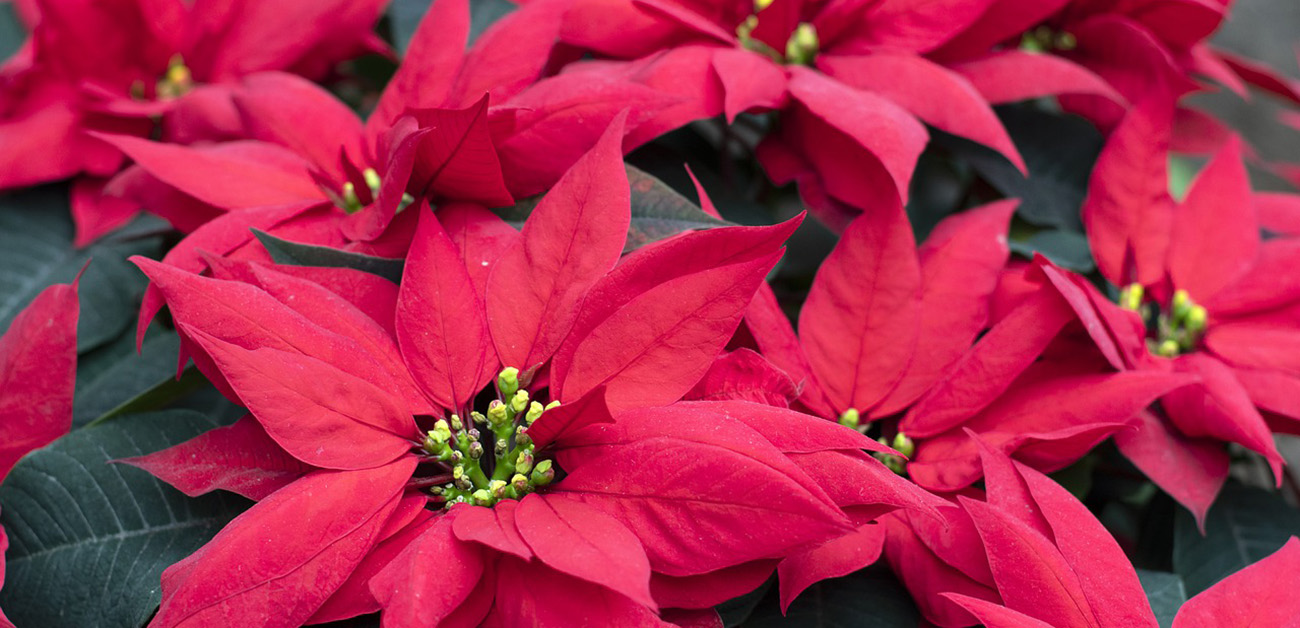
To begin, we are going to have to go back hundreds of years. In what is now Mexico, the flower was originally discovered and used by the Aztecs in the 14th century (Wolford, History and Legends). They called the plant cuetlaxochitl, which means "mortal flower that perishes and withers like all that is pure." (Grace) There are also rumors that they used the brightly colored plant to decorate temples dedicated to the god of the sun: Huitzilopochtli. They had many uses for the plant. Its sap was used to treat fevers, teas were made from its fronds, and red dye was created using its bright red leaves (otherwise known as bracts) (Wolford, History and Legends).
It is strange to consider Poinsettias as having healing properties, as I have heard all my life that you would poison yourself if you ate them. Any medical use the plant may have once had back in the 1300s have been bred out of the plant in favor of making it more beautiful. Now, the plant is mildly poisonous to cats, dogs, and rarely humans. Cats and dogs can experience vomiting, diarrhea and skin irritation when too much of the sap that is in the Poinsettia leaves is eaten. (Klein) The effect is far less pronounced in humans, so you do not have to worry too much if your child nibbles on a leaf or two. According to a study done in 1996, only about 3.5% of people have a reaction when eating Poinsettia, and there has never been a death attributed to the plant (Krenzelok et al. 672).
But back to the history. Over the centuries, Christianity grew rapidly around South and Central America due to the Spanish invasions. This gave the plant significance in Christian culture in places like Mexico, where it was used in nativity processions (Jauron). The plant was called the "Flor de la Nochebuena," (which translates to "Flower of the Holy Night") because of its connection to Christmas there (Wolford, Poinsettia Facts). This led to the plant remaining relevant and allowing it to continue to thrive. Because of this, when a United States Ambassador to Mexico and botanical hobbyist named Joel Roberts Poinsett (I bet you can see where this is going) visited the region of Taxco in 1828 to look for undiscovered plants (Taylor et al. 23). Poinsett did not discover new plants during his trip, but he did find something that he had never seen before.
It can not be proven, but the story goes that while wandering Taxco, Poinsett found a nativity scene that featured la flor de la Nochebuena, and decided to take a few samples to send to America (Taylor et al. 23). Specifically, he sent the samples to his greenhouses he maintained in his hometown of Charleston, South Carolina, where he kept them for a short time before sending them to Pennsylvania (Wolford, History and Legends). While that story is untrustworthy at best, we do know that he was the one who sent the samples from Mexico to somewhere in America.
There is a strong likelihood that he shipped them to Philadelphia instead of Charleston, as records state that one of his colleagues living there sent a cutting out of the country, leading to German botanist Karl Willdenow giving the plant its formal Latin name, Euphorbia pulcherrima, in 1834 (Taylor et al. 24). Somewhere along the way, Poinsettia became the plant’s common name. The most likely reason is that a botanist named Robert Graham gave the Poinsettia its name in a book he published in 1836. Eventually, the name stuck, and we have been calling it the Poinsettia ever since.
But that does not answer how it became an iconic plant for the Christmas season. It had connections in Mexican nativity traditions, but that was not enough to skyrocket it into one of the best selling plants in America. The answer lies with a man named Paul Ecke Sr., who single-handedly orchestrated the Poinsettia’s transformation from an obscure but beautiful plant to the massively popular holiday flower it is today. During the beginning of the 1900s, Ecke and his family, newly arrived from Germany, moved to Los Angeles and settled down (Taylor et al. 24). Once settled, he became interested in the Poinsettia, as it was unique and very colorful. The only problem was that the Poinsettias available in 1900 were gangly, shrublike, and fragile with far fewer leaves than what we see on the modern Poinsettia (Anton). But Ecke was undeterred. Through experimentation, he developed a way to graft parts of Poinsettias together (a technique he managed to keep secret for 80 years), combining the best pieces to one another to create a much more marketable plant over the course of decades.
In the meantime, he still managed to sell enough flowers to relocate to Encinitas in Southern California in 1923, where he planted such a volume of Poinsettias people began to call the city the "Flower Capital of the World." (Chantung) People kept demanding his flowers, which he happily kept supplying. Despite his success, shipment continued to be a problem for Ecke Sr. throughout the first half of the 20th century. Most of the time, plants would arrive damaged or wilting due to their fragility. Even if they managed to remain in perfect condition when delivered, they would only last a couple of days before dying (Taylor et al. 25). This lasted until the 1950s, where horticulturists had multiple breakthroughs in plant conservation that made the flower sturdier.
While the flower did well commercially in America for the first half of the century, it would not be until the 1960s where the Poinsettia really hit its stride as a holiday flower. Ecke Sr.’s son, Ecke Jr. (bet you didn’t see that name coming), began to send hundreds of plants to TV networks for them to put on their Thanksgiving and Christmas specials (Anton). His plan worked, and people began to associate the plant with the holidays, ordering more and more as the years passed. Now, it is the most popular potted plant in both the US and Canada, with over 60 million sold each year in those two countries alone (Whysall)!
So there it is, the history of the Poinsettia from its roots in Aztec culture as a medicinal herb, to becoming part of nativity scenes in Mexico, and then finally becoming a huge part of holiday culture thanks to the Ecke family. I hope you learned something new about the fascinating history hidden behind the red leaves of this plant. Just remember to keep it away from your pets. Have a great holiday!
Works Cited
Anton, Mike. “The Bloom Is off the Poinsettia.” Los Angeles Times, Los Angeles Times, 23 Dec. 2008, www.latimes.com/archives/la-xpm-2008-dec-23-me-poinsettia23-story.html.
Chantung, Margaret. “A Blooming Business: CSUSM Receives Ecke Family Collection.” CSUSM NewsCenter, California State University San Marcos, 18 Apr. 2014, news.csusm.edu/a-blooming-business-csusm-receives-ecke-family-collection-0/.
Klein, Jerry. “Are Poinsettias Poisonous to Dogs?” American Kennel Club, American Kennel Club, 22 Jan. 2019, www.akc.org/expert-advice/vets-corner/poinsettias-poisonous-dogs/.
Grace, Maestra. “‘Cuetlaxochitl, a Gift of Rebirth and Light from Mexico.’” Curanderismo, Curanderismo, 12 Dec. 2019, www.curanderismo.org/post/cuetlaxochitl-poinsettia-a-gift-of-rebirth-and-light-from-mexico.
Jauron, Richard. “The Legends and Traditions of Holiday Plants.” The Legends and Traditions of Holiday Plants | Horticulture and Home Pest News, Iowa State University, 8 Dec. 1995, hortnews.extension.iastate.edu/1995/12-8-1995/trad.html.
Krenzelok, E P et al. "Poinsettia exposures have good outcomes...just as we thought." The American Journal of Emergency Medicine vol. 14,7 (1996): 671-4. doi:10.1016/S0735-6757(96)90086-8
Taylor, Judith M, et al. "The Poinsettia: History and Transformation." Chronica Horticulturae, vol. 51, no. 3, 2011, pp. 23–27., www.actahort.org/chronica/pdf/ch5103.pdf.
Whysall, Steve. “Poinsettia: Christmas Plant since 1825.” Vancouversun, Vancouver Sun, 5 Dec. 2013, vancouversun.com/news/staff-blogs/poinsettia-christmas-plant-since-1825.
Wolford, Ron. “History & Legends.” History & Legends - The Poinsettia Pages - University of Illinois Extension, University of Illinois, web.extension.illinois.edu/poinsettia/history.cfm.
---. “Poinsettia Facts.” History & Legends- The Poinsettia Pages - University of Illinois Extension, University of Illinois, web.extension.illinois.edu/poinsettia/facts.cfm.


